
IT consulting Australia means engaging an external technology partner to assess, plan and improve how a business uses IT, covering cloud strategy, cybersecurity, infrastructure and digital transformation. The value comes from independent expertise, reduced risk and a clear roadmap, delivered by consultants who stay accountable for outcomes rather than handing over a report and leaving.
Most Australian businesses do not need more technology. They need someone who understands their operation well enough to tell them which technology matters and which does not. That is the whole job of a genuine IT strategy consultant: cutting through vendor noise, ranking risk in plain business language, and building a plan the organisation can actually run and afford.
This guide sets out what IT consulting actually involves, the benefits worth expecting, how SCCS structures engagements, and the areas where consulting typically adds the most value. It also includes real outcomes from our own book of business, because generic advice is easy to find and specific, lived experience is not.
Key Takeaways
- IT consulting Australia is about independent assessment and planning, not selling hardware. The lifecycle around a decision matters more than the price of any single box.
- The core benefits are cost reduction, efficiency, innovation and risk management, in that order of what most Boards actually ask about first.
- Cybersecurity advice should rank risk in business terms, not sell fear. Organisations should be safe, not scared.
- A good engagement follows a repeatable process: discovery, strategy, design, implementation and ongoing review, not a one-off audit that gathers dust.
- Real outcomes matter more than glossy frameworks. Ask any prospective consultant for specific, named examples of what changed for a client and why.
SCCS, by the numbers: Five engagement models available to enterprise clients. Four disciplines in our cyber security approach (Assess, Protect, Detect, Recover). More than 150,000 meals funded and over 40 tonnes of technology diverted from landfill through our PonyUp for Good device retirement partnership.
Free, 45 minutes
Not sure where your school or business stands?
Book a free IT health check. We look at your environment, rank the risks in plain English and tell you what deserves attention first. No jargon, no hard sell.
At a Glance: IT Consulting Focus Areas
| Focus Area | What It Solves | Typical Engagement Length |
|---|---|---|
| Cloud strategy and migration | Legacy infrastructure, scaling limits, remote work gaps | Weeks to a few months, staged |
| Cybersecurity posture | Unranked risk, compliance gaps, incident exposure | Ongoing, reviewed on a regular rhythm |
| Infrastructure optimisation | Ageing hardware, network bottlenecks, high support load | Project-based, then continuous management |
| Digital transformation | Manual processes, disconnected systems, poor data visibility | Multi-phase, six months or more |
| Device fleet and procurement | Fragmented buying, no lifecycle plan, e-waste risk | Continuous loop, not a one-off purchase |
What Is IT Consulting, and Why Does It Matter?
IT consulting is the practice of bringing in an independent technology adviser to assess an organisation's systems, identify risk and opportunity, and build a plan to close the gap. It differs from simply buying software or hardware because the consultant's job is to work out what the business actually needs first.
The distinction matters because most technology failures are not technical. They are planning failures. A school buys a firewall without a policy to sit behind it. A council upgrades servers without a continuity plan for the data centre. A retailer rolls out new devices without a support model to keep them running. In each case, the equipment was fine. The plan around it was missing.
Good IT consulting fills that gap. It gives a business technology advisory Australia businesses can act on, expressed in terms a Board, Principal or General Manager can actually use to make a decision, not a stack of jargon that needs translating before anyone can act on it.
The Real Benefits of Strategic IT Consulting
Strategic IT consulting delivers four measurable benefits: lower total cost of ownership, fewer hours lost to preventable problems, technology decisions that support growth instead of blocking it, and risk that is identified and managed before it becomes an incident. Each benefit compounds over time when the advice is followed consistently.
Cost Reduction Without Cutting Corners
The cheapest device, licence or contract is rarely the cheapest outcome once support, downtime and early replacement are counted. A consultant's job is to model total cost of ownership, not just purchase price. This is where the lifecycle view pays for itself: planning, configuration, deployment, support, refresh and retirement all carry cost, and a plan that accounts for all six stages consistently beats a plan that only accounts for the first one.
Efficiency Gains That Free Up Your Team
Every hour a teacher, nurse or tradesperson spends fighting with a login, a slow network or a broken printer is an hour stolen from the job they were hired to do. We call this the teacher test: if technology steals a minute of the lesson, it failed. The same test applies to any frontline role. Efficiency gains from good IT consulting show up as fewer interruptions, not as a line item on a spreadsheet.
Innovation That Fits the Business, Not the Trend
A digital transformation consulting Australia engagement should start with the operation, not the technology. New platforms, automation and AI tools are only worth adopting if they solve a real bottleneck. Good consultants are honest when a trendy platform will not help. That honesty is worth more than a roadmap full of buzzwords the business will never use.
Risk Management Built In, Not Bolted On
Security, backup and continuity should be part of the original design, not an afterthought added after an incident. For organisations that want to be safe, not scared, risk should be ranked and explained in business terms, so leadership understands exactly what they are buying and why. If something is already fine, a trustworthy consultant says so, rather than manufacturing urgency to justify a sale.
How SCCS Approaches Client Engagements
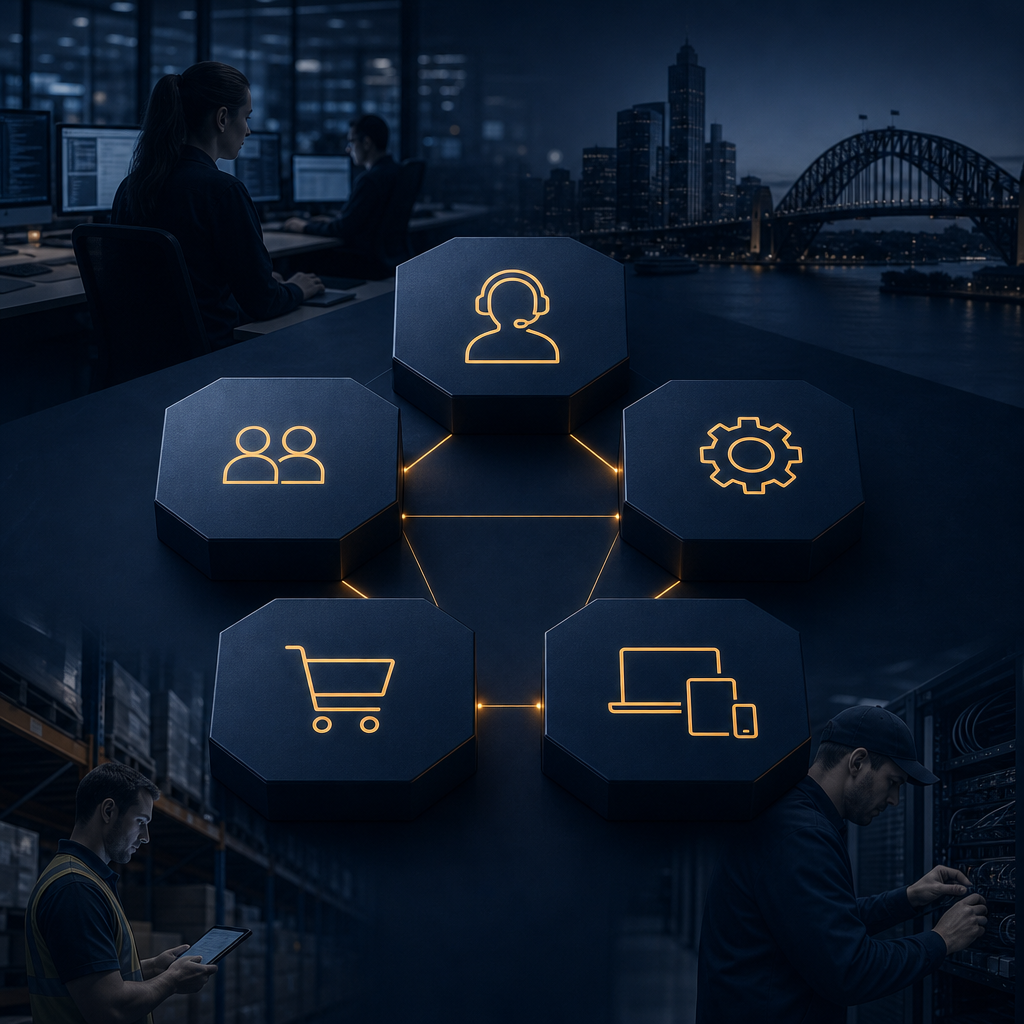
SCCS shapes every engagement around the client's existing operating model rather than forcing a fixed package. We call this the five engagement models: Fully Managed IT, Co-Managed and Specialist Services, Projects and Field Services, Enterprise Procurement and Lifecycle, and Device as a Service. Most enterprise clients combine two or more, depending on where they need the most support.
This matters because most organisations do not fit neatly into one category. A national retail brand needing device fleet deployment and support across dozens of sites does not need the same model as an independent school needing network, cyber security and daily support handled end to end. In the retail case, SCCS managed the fleet, deployment and ongoing support at scale, and the organisation ended up with one accountable partner across its whole estate instead of a fragmented list of vendors.
We build engagements as building blocks, not packages. That means the client only pays for the components they actually need, backed by our advisory team, who stay on the account rather than handing off to a rotating cast of account managers. Our view is straightforward: project contractors leave, but partners answer the phone. The same people who design the solution are the ones who support it afterwards.
Common Areas Where IT Consulting Adds Value
The consulting areas Australian businesses ask about most are cloud strategy, cybersecurity posture, infrastructure optimisation and digital transformation. Each has a distinct process, but all four share the same underlying discipline: assess before acting, and review on a set schedule rather than waiting for a problem to force the issue.
Cloud Strategy and Migration
Cloud and hybrid-cloud moves work best as a staged process, not a single risky cutover. We follow a simple sequence: Assess the current environment and workloads, Migrate in planned stages, then Manage the environment on an ongoing basis. Rushing the migration step is the single biggest cause of downtime we see in Microsoft 365 and Azure projects.
Cybersecurity Posture
Cyber security is not one product. It is four disciplines working together in the right order, reviewed on a regular rhythm: Assess, Protect, Detect, Recover. Assessment ranks the real risks. Protection closes the highest-priority gaps first. Detection catches what gets through. Recovery makes sure an incident is a bad day, not a bad year. Where relevant, we benchmark this against the Australian Cyber Security Centre's Essential Eight maturity model.
Infrastructure Optimisation
Ageing servers, congested networks and undocumented systems drive up support costs quietly, year after year. A government team we worked with needed data centre infrastructure and continuity designed specifically for uptime. SCCS built and supported that environment, and the outcome was resilience that the team's own auditors could sign off on, which is a very different bar to clear than simply having the lights stay on most days.
Digital Transformation Consulting
Digital transformation consulting Australia projects fail most often when the technology outruns the people using it. The independent school example is instructive here: the brief was network, cyber security and day-to-day IT support, all handled end to end. SCCS took full responsibility for that scope, and the practical result was that staff could go back to teaching instead of troubleshooting. That is the actual measure of a successful transformation project: less friction, not more features.
A Typical IT Consulting Engagement, Step by Step
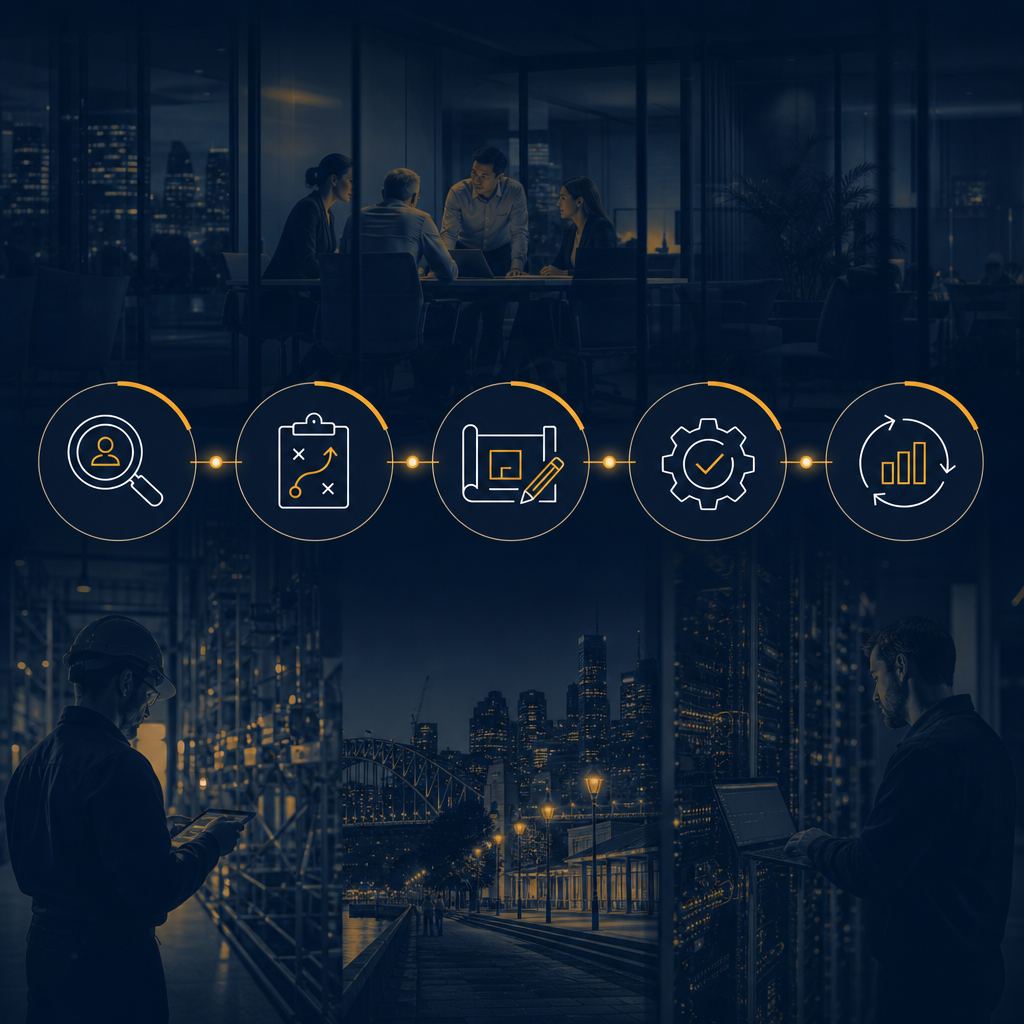
A typical IT consulting engagement runs through five stages: discovery and assessment, strategy and roadmap development, solution design, implementation, and ongoing review. Each stage produces a decision point, so the client always knows what happens next and why, rather than waiting for a single large report at the end.
- Discovery and assessment. We map current systems, risks and pain points, and talk to the people who actually use the technology daily, not just the people who bought it.
- Strategy and roadmap. Findings are translated into a prioritised plan, ranked by risk and business impact, in language a Board or Principal can act on without a glossary.
- Solution design. The plan becomes a concrete design, whether that is a cloud migration path, a security control set, or a device lifecycle plan.
- Implementation. The same people who designed the solution deliver it, which avoids the handover gap that causes most project delays.
- Ongoing review. Cyber security, infrastructure and cloud environments are reviewed on a set rhythm, not left to drift until something breaks.
Clients can start this process by booking a consultation, and organisations that already have day-to-day support in place through managed services often layer strategic consulting on top, rather than replacing one with the other.
Why the Lifecycle Matters More Than the Box Price
Most procurement conversations in Australia still start and end with unit price. Our position is the opposite: devices are the easy part, the lifecycle is the work. Anyone can find a cheaper laptop on the internet. Almost no one can find a cheaper way to plan, configure, deploy, support, refresh and retire a fleet of them without creating security gaps and unplanned cost along the way.
We see this most clearly through our PonyUp for Good partnership, which handles the retirement stage that most procurement conversations ignore entirely. When client device fleets reach end of life, data security and electronic waste both become live risks. Our approach retires the technology properly: data is destroyed, devices are refurbished and resold, and half of the profits are converted into meals for people in need. That partnership has now funded more than 150,000 meals and diverted more than 40 tonnes of technology from landfill. Those are not marketing numbers. They are the direct result of treating retirement as part of the job, not an afterthought once the new devices arrive.
The feedback we hear most consistently from clients across school, government and enterprise engagements is not about a specific feature or platform. It is that having one accountable partner, who knows the environment and picks up the phone, removes a category of stress that a rotating list of vendors never could. That is the outcome we measure ourselves against: quiet weeks, not ticket counts.
References
- Australian Cyber Security Centre (ACSC), Essential Eight Maturity Model: https://www.cyber.gov.au/resources-business-and-government/essential-cyber-security/essential-eight
- Australian Bureau of Statistics (ABS), Business Characteristics Survey: https://www.abs.gov.au
- Australian Institute of Company Directors (AICD), Governance and cyber security resources: https://www.aicd.com.au
- Digital Transformation Agency (Australian Government): https://www.dta.gov.au
Free download
The School IT & Cyber Readiness Checklist
Twelve points, ten minutes with a highlighter, and you know exactly what to fix first.
Frequently asked questions
What ROI can I expect from IT consulting?
Return on IT consulting shows up as avoided cost more often than new revenue: fewer outages, less emergency spend, and devices and licences that last their full useful life. The clearest ROI comes from replacing reactive, unplanned spending with a predictable, reviewed plan.
What should I expect from an IT consulting engagement?
Expect a discovery phase, a ranked plan in plain business language, a concrete design, hands-on implementation, and a scheduled review cycle afterwards. A trustworthy consultant explains what is already working, not just what needs fixing.
How do I choose the right IT consultant in Australia?
Look for a consultant who ranks risk honestly, names real outcomes from past work, and keeps the same people involved from design through to ongoing support. Be wary of anyone who sells urgency before they have assessed anything.
Is IT consulting different from managed IT services?
Yes. Consulting is advisory: assessment, strategy and design. Managed services is the ongoing delivery of day-to-day IT support, monitoring and maintenance. Many organisations use consulting to set direction, then use managed services to run it.
How long does a typical IT consulting engagement take?
Discovery and strategy phases often run a few weeks. Implementation timelines depend on scope, from a single cloud migration measured in weeks to a multi-site digital transformation programme measured in months.
Do small and medium Australian businesses need IT consulting, or is it only for large enterprises?
Smaller organisations often benefit the most, because they typically lack an internal team to plan ahead of problems. The engagement scope is simply smaller, focused on the highest-priority risks first.

Ian Pearce
General Manager, Sales and Services at Southern Cross Computer Systems
Keep reading